Wednesday, 29 March 2017

ABOUT DOWN SYNDROME

Down syndrome (DS), also called Trisomy 21, is a condition in which a person is born with an extra chromosome. Chromosomes contain hundreds, or even thousands, of genes. Genes carry the information that determines your traits (features or characteristics passed on to you from your parents). With Down syndrome, the extra chromosome causes delays in the way a child develops, mentally and physically.
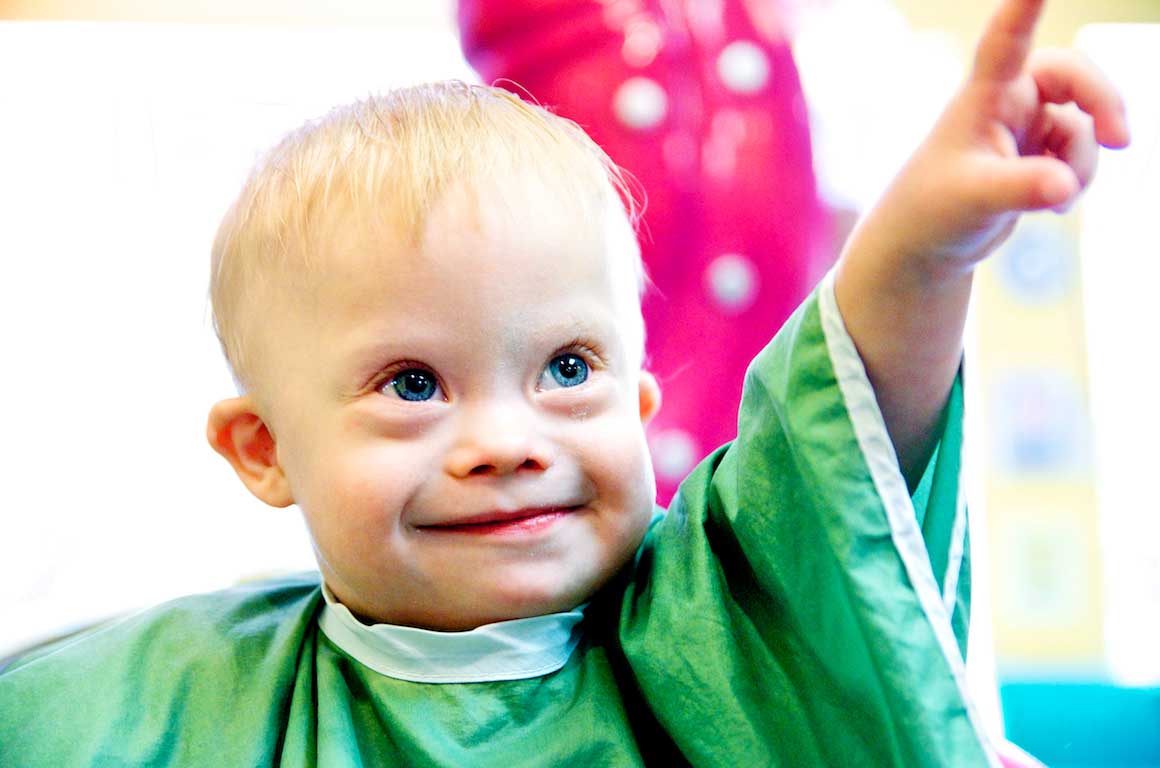
Image result for DOWN SYNDROME KIDSThe physical features and medical problems associated with Down syndrome can vary widely from child to child. While some kids with DS need a lot of medical attention, others lead healthy lives.
Though Down syndrome can't be prevented, it can be detected before a child is born. The health problems that may go along with DS can be treated, and many resources are available to help kids and their families who are living with the condition. 

What Causes It?

Image result for DOWN SYNDROME KIDSNormally, at the time of conception a baby inherits genetic information from its parents in the form of 46 chromosomes: 23 from the mother and 23 from the father. In most cases of Down syndrome, a child gets an extra chromosome 21 — for a total of 47 chromosomes instead of 46. It's this extra genetic material that causes the physical features and developmental delays associated with DS.
Although no one knows for sure why DS happens and there's no way to prevent the chromosomal error that causes it, scientists do know that women age 35 and older have a significantly higher risk of having a child with the condition. At age 30, for example, a woman has about a 1 in 1,000 chance of conceiving a child with DS. Those odds increase to about 1 in 400 by age 35. By 40 the risk rises to about 1 in 100.
Image result for DOWN SYNDROME KIDS 
PUBLISHED BY : FARHATUL SYAHIRAH

Tuesday, 28 March 2017

WHAT IS AUTISM ?

People usually call it autism (say: AW-tiz-um), but the official name is autism spectrum disorders. Why? Because doctors include autism in a group of problems that kids can have, including Asperger syndrome and others. These problems happen when the brain develops differently and has trouble making sense of the world and helping someone communicate. 
Image result for autism kids
A kid's symptoms could be very mild, severe, or somewhere in the middle. Someone with mild symptoms might need only a little bit of help. But a kid with severe symptoms might need a lot of help with learning and doing everyday stuff.Every day, our brains interpret (understand) the things we see, smell, hear, taste, touch, and experience. But when someone's brain has trouble interpreting these things, it can make it hard to talk, listen, understand, play, and learn.
Kids with autism often can't make connections that other kids make easily. For example, when people smile, you know they feel happy or friendly; when people look mad, you can tell by their face or their voice. But many kids who have autism spectrum disorders have trouble understanding what emotions look like and what another person is thinking. They might act in a way that seems unusual, and it can be hard to understand why they're doing it.
 Related image                                                                                                               
A kid with an autism spectrum disorder might:
  • have trouble learning the meaning of words
  • do the same thing over and over, like saying the same word
  • move his or her arms or body in a certain way
  • have trouble adjusting to changes (like trying new foods, having a substitute teacher, or having toys moved from their usual places)
Imagine trying to understand what your teacher is saying if you didn't know what her words really mean. It is even more frustrating if a kid can't come up with the right words to express his or her own thoughts, or tell a parent what he or she needs or wants. Sometimes this can make a kid very upset and frustrated.
Some issues — like not wanting to try new foods or not wanting anyone to move your toys — affect lots of kids, not just those who have an autism spectrum disorder. But kids with these disorders may have more trouble learning to handle stuff that's challenging and annoying. 
PUBLISHED BY: FARHATUL SYAHIRAH

UNDERSTANDING DYSLEXIA

Reading may seem easy and automatic for people who master it without difficulty. However, reading is a complex and challenging task for our brains, so we shouldn't be surprised that so many kids struggle with it.
In fact, about 15% to 20% of the U.S. population has a specific reading disability called dyslexia, which is the major cause of reading failure in school. Dealing with this learning challenge can lead to frustration and self-doubt, especially when it goes undiagnosed for a long time.
The good news is that dyslexia can be identified early and kids who have it can be taught to become successful readers.

Image result for dyslexic kids Most kids begin learning to read by learning how speech sounds make up words (phonemic awareness) and then connecting those sounds to alphabet letters (phonics). Then they learn how to blend those sounds into words and, eventually, they can instantly recognize words they've seen many times before.
Reading is a little like riding a bike: it requires doing many things at once with precise timing. With practice, typical readers gradually learn to read words automatically so they can focus their mental energy on comprehending and remembering what they've read.
Kids with dyslexia, though, have trouble with phonemic awareness and phonics. Research shows that dyslexia happens because of subtle problems in information processing, especially in the language regions of the brain. For this reason, reading doesn't become automatic and remains slow and labored. When a child struggles with these beginning steps in reading, comprehension is bound to suffer and frustration is likely to follow.
A common assumption about dyslexia is that letters or words appear reversed; i.e., "was" appears like "saw." This type of problem can be a part of dyslexia, but reversals are very common among kids up until first or second grade, not just kids with dyslexia. The major problem for kids with dyslexia is in phonemic awareness, phonics, and rapid word recognition.
published by: Farhatul Syahirah

FUN PLACES FOR KIDS IN MALAYSIA


 We are very lucky people living in Malaysia where there are lots of theme parks, great outdoors and malls to spend our leisure time in. There is always something for everyone!
Here is a list of fun places where the whole family can enjoy kid-friendly activities:


Angry Birds Activity Park

Image result for angry birds activity park

This 26,000 sq ft state of the art activity park is strategically located in the premises of KOMTAR JBCC, Johor Bahru City Centre’s newest premier shopping, dining and entertainment destination. The park offers a wide variety of fun games and attractions for toddlers, kids youth and parents such as the Lazer Bird Shoot, Red Bird Goal, Piggy Shooting Gallery and Captain Black Bird Ship.


Puteri Harbour Family Theme Park

Located strategically in Nusajaya Johor, 20 minutes drive from the Malaysia-Singapore Second Link, 25 minutes away from the Senai International Airport or 10 minutes away from LEGOLAND® Malaysia.
  • Sanrio Kitty Town                                                                                                       “The first Sanrio Hello Kitty theme park outside of Japan, consists of various walk-through attractions, interactive activities and rides which follow the Hello Kitty theme. Key features include, Black Wonder, a hi-tech interactive themed experience and Kitty House, an iconic Hello Kitty house complete with living room, bedroom, bathroom and kitchen. Visitors can also look forward to the “Purrfect” stage which will house Hello Kitty and her friends where they will showcase a live performance.” 

  •                                                                                                                                                                                                                                                                                                                                                                                                                                                                                                                                                                                                                                                                      
  • Little Big Club
                                                                                                                                                                 Children can interact with all of their favourite HiT characters; Thomas & Friends, Barney, Bob the Builder, Angelina Ballerina and Pingu under one roof! At each of the 6 themed interactive play zones, children can join in the fun with games, rides, soft play areas, and more.

  •                                                                                                                                                                                                                                                                                                                                                                                                                                                                                                              

  • Lat’s Place                                                                                                                                                                                                                                                                  “LAT’s Place, a themed restaurant which will bring the world of legendary local cartoonist, Dato’ Mohd Nor Khalid or Dato’ Lat’s famed Kampung Boy (Village Boy) character to life.” - 


  • Related imageShah Alam Wet World Water Park
    Child-friendly - no part of the water level in this park is more than one metre deep.

    Water attraction includes the Fountain of Youth, Cascading Waterfalls, Neptune Challenge, Atlantis City, Big Splash, Lighthouse Escape, Tunnel Water Slide, and Treasure Island. The greatest thrill of all however is the Monsoon Buster ride, one of the world’s longest uphill water coaster rides at 225 metres long.


    i-City Shah Alam

                                                                                                                                           
     SNOWALK                                                                                                               Experience a winter wonderland in Snowalk and admire an amazing forest of lights.


    WATERWORLD
    Boasts a 49m Tornado Slide amongst other water attractions to keep kids of all ages entertained.


                                                                                                                                                                                                                                                                                                                                                                                                                                                                                                                                                                                                                Legoland Malaysia   
                                                                                                                                                                   LEGOLAND Malaysia has seven themed areas of attractions for all ages such as The Beginning, LEGO®Technic, LEGO Kingdoms, Imagination, LEGO City, Land of Adventure and MINILAND. It’s an inspirational land where the children are the heroes. From LEGO experiment centres to rollercoasters, the park is a day-long voyage of discovery for all the family.


                                                                                                                                                                          PUBLISHED BY : Farhatul Syahirah 


Monday, 27 March 2017

The view after taking the course of Diploma of early childhood in semester two

Before I was take this course, I not understand the mind of a child, for me the child is arrogant and spoil brat maybe because the way of certain parent of teaching or the way child was teach at school and many more that I wish to write here and yet I also notice that not all children behave the same, it was weird and kind of interesting to know why. That is the real reason why I choose this course. When I was in semester one at KOLEJ POLY-TECH MARA LEMBAH SIREH KOTA BHARU KELANTAN MALAYSIA, the info about the mind of a child shock me cause it was different from my experience with my nephew that for sure I knew about everything about children, it was proven me wrong. The basic of children is that they cannot lies in first place and their mind is pure that they can absorb everything in second by their eyes, they also learn by copying their guardian.  After finished the first semester, the conclusion is that children is special human in early state before become an adult, the personality of an adult lies in their childhood memory. Now I in semester two, I will finish this course in two more years yet I hopes to find out more about children and how to educate them to become better student and person.


physical abuse of children

Physical abuse by the Children Act 2001 is when a child is physically injured causing visible injuries on any part of the body of the child as a result of violence or deliberate use of agents to the body of the child. Physical injury (ranging from minor to severe fractures or death). Caused by punches, slaps, kicking, biting, shaking, throwing, stabbing, choking, hitting (with hands, sticks or other objects), or anything that hurt children. Identified as abuse regardless of whether the caretaker intended to hurt the child or not. There is often no intention to hurt or cause injury it could be because of the purpose of the excessive discipline or physical punishment. Interruption of crying babies and inability to control it. Bullying and "shaken baby syndrome" is a kind of physical abuse.


published by ; nik shima

3 Transportation Activities For Preschoolers

Transportation and things that move are a highly interesting topic for toddlers. Fascinated by how things go and get us from place to place, children enjoy discovering more about cars, trains, planes, boats, trucks and other ways to get around through exciting transportation activities for preschoolers.

Why is transportation such a popular area of interest for preschoolers? This topic is part of their everyday lives. They may be driven or walk to preschool, have seen or ridden in a bus or train, and may have traveled in an airplane to go on vacation. Children have a natural interest in transportation as it is something they experience in the world around them.


1. I’m Going on a Trip…
       *During circle time, begin this game by saying, “I’m going on a trip by…” (i.e. train). The next child in the circle will continue the game by saying, “I’m going on a trip by train and airplane.” Each child will add another mode of transportation. See how many types of transportation you can name!

2. Red Light, Green Light
    *Create a green, yellow and red card to represent traffic signals. Ask preschoolers to walk around your classroom. Hold up the green card, saying “Green light.” Children must walk faster (without running). Next, show the yellow card and say, “Yellow light.” Children should walk in slow motion. Show the red card and say, “Red light.” Children must stop completely and stay still. Alternate the colors in random order!

3. Vacation Station
     *Set up a space for dramatic play by arranging chairs as if they were seats on a bus, plane or train. Add pretend food and trays, suitcases and clothing to recreate the travel atmosphere. Ask preschoolers to make tickets out of paper and use hole punchers to mark tickets as passengers board the vehicle.


published by : Nik Shima